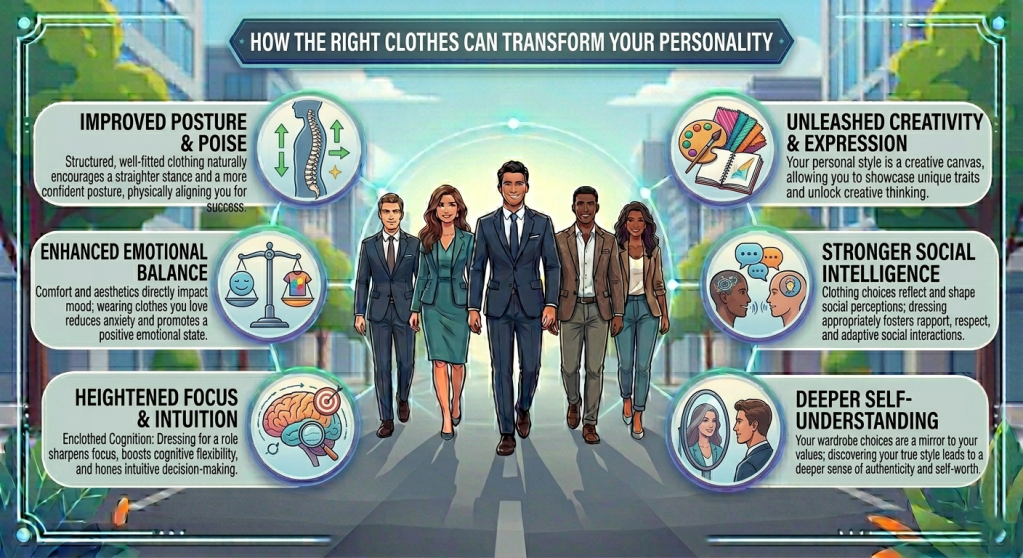
Some people swear they become a different version of themselves the moment they put on a certain jacket. Others say a specific pair of boots makes them walk taller, talk louder, take up more space in a room.
This isn’t just a feeling people made up to justify shopping. Clothing can genuinely shift how someone behaves, not just how they feel inside. That’s a different claim than “clothes boost confidence,” and it’s worth taking seriously on its own terms.
The interesting part is how small the trigger can be. A single piece, sometimes found through nothing more than a lucky yard of deal at the right moment, can be enough to nudge someone toward a noticeably different way of carrying themselves.
Let’s look at how that transformation actually works, and where its limits are.
Transformation Versus Confidence: What’s the Difference?
Confidence is a feeling. Transformation is a behavior change. They’re related, but they’re not the same thing, and conflating them misses something important about how clothing actually works on people.
Someone can feel more confident in an outfit without acting any differently. True transformation shows up in observable shifts: speaking up more in a meeting, taking a different posture, approaching a stranger at a party, making a bolder decision than usual.
This distinction matters because it explains why some outfits just feel nice, while others genuinely seem to change how a person operates for the rest of the day.
The “Costume Effect”
Psychologists sometimes describe this as a costume effect. When clothing carries strong symbolic weight, a uniform, a specific cultural garment, an outfit tied to a particular role, the wearer can start unconsciously adopting traits associated with that symbol.
This goes beyond simple mood improvement. It’s closer to temporarily stepping into a different version of yourself, one the clothing gives you permission to access.
Real Examples of Clothing-Driven Personality Shifts
Abstract psychology aside, this shows up in plenty of everyday, observable situations.
The Work Uniform Effect
People in service or trade jobs often describe a noticeable shift when putting on a uniform. The uniform signals “I’m at work now,” and behavior shifts to match, sometimes including more patience, more structure, or more assertiveness than the same person might show off the clock.
This isn’t about pretending. It’s the clothing reinforcing a specific mode of behavior tied to that role.
The “Going Out” Outfit
Many people have a specific outfit reserved for nights out, one that makes them noticeably more talkative, more willing to dance, or more comfortable approaching strangers compared to how they’d act in everyday clothes.
This is transformation in its most visible, social form. The clothing isn’t just making someone feel good; it’s actively changing how they engage with other people.
Athletic Wear and Physical Confidence
Putting on workout clothes specifically designed for performance, rather than just lounging in old gym clothes, has been linked to increased motivation and more assertive physical behavior during exercise. The clothing primes a more determined mindset before the workout even starts.
Formal Wear and Decision-Making Style
Some research has connected formal clothing to more abstract, big-picture thinking, while casual clothing correlates with more detail-focused, concrete thinking. This suggests clothing might even shift how someone approaches problem-solving, not just how they feel about themselves.
What Makes a Piece of Clothing Transformative
Not every item in a closet carries this kind of weight. Certain factors seem to matter more than others in triggering an actual behavioral shift.
Strong Personal or Cultural Symbolism
The clothing needs to mean something specific to the wearer. A plain shirt rarely transforms behavior. A graduation gown, a uniform, or a piece tied to a meaningful personal milestone carries far more behavioral weight.
Novelty or Specialness
Everyday clothing, worn constantly, tends to lose its transformative power simply through repetition. A special piece, reserved for specific occasions, often retains a stronger psychological effect precisely because it’s not diluted by daily use.
This is part of why a single great find, even something snagged through an unexpected yard of deal, can become a genuinely transformative wardrobe staple if it’s saved for the right moments rather than worn into the ground immediately.
Fit and Physical Sensation
Clothing that physically feels different, structured shoulders, a fitted waist, an unusually weighted fabric, tends to create a stronger bodily awareness that feeds into behavioral change. Subtle physical cues seem to reinforce the mental shift more than purely visual ones.
Can Anyone Use This Intentionally?
Yes, to a meaningful degree. While clothing transformation often happens unconsciously, it can also be deliberately engineered.
Building a “Mode-Switching” Wardrobe
Some people deliberately designate specific pieces for specific mental modes: one outfit for focused work, another for social confidence, another for physical activity. Over time, putting on that designated piece becomes a trigger for the associated mindset, almost like a personal ritual.
This works best when the association is reinforced consistently. Wearing the “focus” outfit only during genuinely focused work, rather than randomly, strengthens the link between the clothing and the desired behavior.
Starting Small
Transformation doesn’t require a dramatic wardrobe overhaul. A single new piece, deliberately chosen for how it makes you move or feel, can be enough to test this effect without major investment.
This is where patience around shopping pays off. Waiting for the right piece, even if that means holding out for a real yard of deal rather than settling for something generic, often produces a far more meaningful transformative item than an impulsive purchase.
The Limits of This Effect
It’s worth being honest about where this idea has boundaries. Clothing can shift mood, behavior, and even temporary mindset, but it doesn’t permanently rewrite personality or fix deeper personal challenges.
It’s a Nudge, Not a Cure
If someone struggles significantly with social anxiety, a great outfit might help at the margins, but it won’t resolve the underlying issue on its own. Treating clothing as a complete solution rather than a helpful tool sets unrealistic expectations.
The Effect Fades With Overuse
Wearing the same “transformative” piece every single day eventually strips away its special psychological weight. The novelty and symbolism that made it powerful in the first place gets worn down through repetition, much like the fabric itself.
Context Still Matters
A transformative outfit in the wrong setting can backfire, creating a mismatch between behavior and environment rather than a positive shift. The effect works best when the clothing and the context align.
Conclusion
The right clothes can genuinely transform behavior, not just mood, by tapping into symbolism, novelty, and physical sensation in ways that nudge people toward different versions of themselves. This goes beyond simple confidence; it shows up in how people actually act, speak, and engage with others.
This kind of transformation doesn’t require an expensive wardrobe overhaul. Sometimes it just takes one meaningful piece, chosen with intention and occasionally found through a genuine yard of deal, to unlock a noticeably different way of showing up.
Used thoughtfully, and with realistic expectations about its limits, clothing becomes more than fabric. It becomes a quiet, surprisingly effective tool for shaping how you move through your day.
FAQs
1. Is clothing-driven personality transformation backed by real research? Yes, to an extent. Studies on enclothed cognition and symbolic clothing suggest clothing can influence behavior and thinking style, not just mood, though it works alongside personality rather than replacing it.
2. Why do “special occasion” outfits feel more transformative than everyday clothes? Novelty and reduced repetition help preserve the psychological weight of an item. Clothing worn constantly tends to lose its behavioral impact over time.
3. Can I deliberately use clothing to shift my mindset? Yes. Many people designate specific outfits for specific mental modes, like focus or social confidence, reinforcing the association through consistent, intentional use.
4. Does this mean buying more clothes will improve my personality? Not necessarily. The effect comes from meaningful, intentional choices, not quantity. A single well-chosen piece, even one found through a smart yard of deal, often works better than an overflowing closet.
5. Are there limits to how much clothing can change behavior? Yes. Clothing can nudge mood and behavior, but it doesn’t resolve deeper personal challenges or permanently alter personality on its own.


